Showing posts with label Home. Show all posts

Monday, 27 February 2017

Yanga will not be carried away - Coach


YOUNG Africans will not get carried away by the mammoth 5-1 first leg win over Comoro side Ngaya Club de Mde in their African Champions League preliminary round tie, assistant coach Juma Mwambusi has said.


The Mainland envoys in the continental premium club competition returned home yesterday from Moroni, where they made the light of the Comoro minnows over the weekend. Goals from Justin Zullu, Simon Msuva, Obrey Chirwa, Amissi Tambwe and Thaban Kamusoko apiece wrapped a massive win for George Lwandamina’s side at the Stade de Moroni.
The Tanzanian champions now have a comfortable lead to take into what appears to be a mere formality return fixture next weekend at the National Stadium in Dar es Salaam. However, Mwambusi insisted that they will not rest on their first leg success and promised a solid performance in the reverse game.
“We have won the first leg and there is another match to play, it is important that we get the right preparations so that we get the job done and get into the next round,” Mwambusi told reporters at Julius Nyerere International Airport (JNIA).
“It is not over yet, we beat them at home and they can come with a different approach. What we need is to make sure we play well and defend our lead, we have one leg in the next round, but we must finish off the job,” he added. Hundreds of jubilant Young Africans supporters turned at the JNIA yesterday afternoon to welcome their team back home.
The Mainland champions will face the winner of the tie between Zambia’s Zanaco and APR of Rwanda. The first leg played in Lusaka ended in a barren draw. The first round fixtures will be played on the weekends of March 11-13 and 17-19.

Chelsea and Diego Costa yet to agree terms on new contract - Sky sources

Chelsea are in advanced talks with Diego Costa, but are yet to agree a new contract, according to Sky sources.

Media reports on Tuesday suggested that a deal had been struck to keep the Spain international at Stamford Bridge, but Sky sources understand that they are premature.
Costa - who has two full seasons left on his current contract - has scored 
15 Premier League goals this season to help propel Chelsea into an eight-point lead at the top of the table.
But he was heavily linked with a move away from west London in the January transfer window, with Chinese club Tianjin Quanjian appearing to be a potential destination.
The 28-year-old was pictured training on his own after falling out with boss Antonio Conte.
But the pair patched up their differences and he was restored to the first team. Conte said last month that he expected Costa to stay with Chelsea for a long time.
Costa has been a huge hit at Chelsea since his £32m move from Atletico Madrid in the summer of 2014.

Arsenal's loss to Bayern Munich is 'embarrassing' for the club, says Paul Walsh

Arsenal's 5-1 defeat to Bayern Munich in the Champions League was an "embarrassment" for the club, according to Sky Sports expert Paul Walsh.
Barring an unlikely four-goal turnaround at the Emirates Stadium on March 7, Arsene Wenger's side are set to exit at the last-16 stage for the seventh season in a row after goals from Arjen Robben, Robert Lewandowski, Thiago (2) and Thomas Muller condemned them to a heavy loss at the Allianz Arena.

Defender Laurent Koscielny limped off injured four minutes after half-time but, after watching the game in the Sky Sports News HQ studio, Walsh said there could be no excuses.

"It turned into a bit of an embarrassment," he said. "Bayern absolutely battered them in the end and it is embarrassing, that's official.
"We can look to make excuses for what happened, but ultimately they were just outplayed.
"The nature of the second goal, Lewandowski got a header. Could you say it was because Koscielny wasn't in the defence? No. Gabriel is a big strong defender.
"Once Bayern got their noses in front they kept passing and moving it in great positions. In the second half I can't really remember Arsenal creating anything, which is disappointing.
"If they could have just stayed in the game at 2-1 or even 3-1, but it is difficult when their top players, Mesut Ozil and Alexis Sanchez are not even getting a touch. They couldn't even get a kick of the ball because Bayern were keeping it so well.
"It's really demoralising and in the end they just picked Arsenal off."
Walsh believes the result will fuel calls for Wenger to stand down as manager after more than 20 years in charge.
And he says that change is now looking likely to happen.
"This is just playing into the hands of the Wenger out camp," he added.
"'It's the same old Arsenal. Familiarity almost breeds contempt for some of the supporters who just want a change.
"They are bored. They want something different. They might get that in the near future and it will be interesting to see how Arsenal move forward then."
David Ospina was preferred to Petr Cech in goal, but Walsh refused to blame him, instead pointing at star names such as Ozil and Sanchez.
"We were questioning Ospina before the game, but he had a really good game and made several good saves. The goalkeeper was nothing to do with it.
"No continuity at centre-half and you could argue that unsettled the back four and made it harder, but I'm looking for reasons. They were beaten by a better team.
"Sanchez and Ozil are their saviours in the Premier League, but they hardly featured in tonight's game. That shows you how little of the game they were in.
"At this stage of this competition you come up against good teams and they came up against a much better team tonight who deserved to win by a million miles in the end."

US Soccer President Sunil Gulati Defends The Lack Of Pro/Rel In America

Promotion and relegation remains a hot-button issue in American soccer. While the vast majority of soccer fans tend to not think about the division pyramid and whether the Pittsburgh Riverhounds can play in MLS without paying upwards of $100 million, the debate has been kept alive by one dedicated zealot and his merry band of Pro/Rel Truthers. Their greatest enemy, as they will happily explain to you (whether you want them to or not), is an entrenched corporatized establishment in American soccer that prioritizes big business over fans and community-minded clubs. 

These league structure clerics may be feeling a bit more agitated than usual today.

That’s because of recent comments by USSF president Sunil Gulati addressing the lack of promotion and relegation in American soccer. In an interview with Grant Wahl for Sports Illustrated, Gulati tackled the issue head-on and offered an assessment of how likely it is that pro/rel would finally come to America. His take, in essence: “don’t hold your breath.”

”There are a number of issues that come up with that particular format of competition, but the biggest one is it’s not the rules of the game that people bought into when they made investments, whether it’s in the USL, the NASL or MLS. It’s not the rules that we set out when teams came in. And so whether that happens or not, is it possible? Sure. Is it going to happen in the next few years? I don’t think it is, but it’s not going to be that we dictate it should happen or shouldn’t happen. You’ve got investments that have been made. And so if the leagues get together and say we should look at this, are we willing to help facilitate that discussion? Sure, we’d be willing to. But if you make an investment today and the next day the government—in this case, us—changes the rules completely and changes the value of your investment? That’s going to lead to some serious problems. That’s point one.” 

But wait— there’s more.

”Point two: I’ve seen a lot of the empirical evidence on it, and there’s not a lot of empirical evidence on the benefits and costs of a promotion/relegation system. Yes, there was the Deloitte study, and I’ve met with the author of that and we’ve talked about it. But for example, one of the benefits that comes out there is that teams that are at the bottom in a particular first division, let’s say, will do whatever they have to to make investments to stay up, so that increases the competition. O.K., that’s true. But in a salary cap world, is that true? The answer is no. It can’t be.” 

You can catch Gulati’s full comments at the link above. It’s definitely worth a listen, regadless of whether or not you agree with his appraisal.

Exclusive: Tense meeting between Barcelona players and staff as errors discussed

The heavyweights did not stop talking and discussing the disaster at Parc des Princes. It is usually the coaches who speak loudest in these meetings but the players are also allowed to express their opinions.


After matches Luis Ernique usually calls a meeting with his players to analyse the game in question, look for errors and possible things to improve in the coming games. This Wednesday was no exception and he met up with the staff first to analyse what happened against PSG.
However this meeting was different from the others. And not because of the time it took, which was a longer than usual 25 minutes, but for the content, which laid bare the tension there is in the dressing room.
The heavyweights did not stop talking and discussing the disaster at Parc des Princes. It is usually the coaches who speak loudest in these meetings but the players are also allowed to express their opinions.
This meeting was especially tense. The way they came out of it made it clear that it was also cathartic. Long faces, few words and seriousness were the common denominator for the group in training, who want to get rid of the Paris game from their hard disk. 

Barcelona and Luis Enrique: Is there any way back from this humiliation?


“We tried to score to get back into the tie but they got the third goal and then the fourth,” the Barcelona manager, Luis Enrique, said at the end of his darkest night. His words were telling but not even entirely true.
It was not that Paris Saint-Germain had scored a goal; it was that they had scored a third and then a fourth, and anyway it was not as if the visitors had been caught chasing the game, a quick counter or some fluke goal cruelly ending it. When Ángel Di María curled in the third, the finish was as calm and precise as the move that led to it, a portrait from the Parc des Princes, a portrait of Barcelona, too.


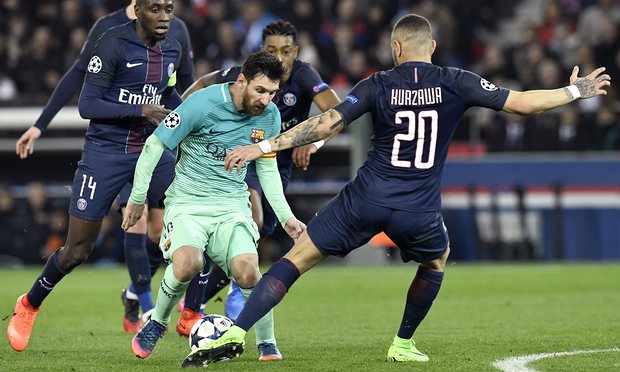
There were many of them, defining images. Lionel Messi losing the ball, stopping and then watching PSG escape to score was the most seized upon. But there was also the ease with which they were overcome, one after the other all the way to Andrés Iniesta, for the third on 55 minutes.
Barcelona’s resistance had not been broken there, their rebellion suddenly over, as Luis Enrique implied, and it did not continue thereafter; it never truly began. Ten minutes earlier the second half had started, a second chance. Instead there was another portrait, perhaps most powerful of all. Barcelona had the kick-off and immediately lost the ball. They had not even escaped the centre circle, still less PSG.
Overwhelmed, unable to react, Barcelona were taken apart. Nor was it only pace or intensity, although this was their 13th game in 41 days and Iniesta certainly was not fully fit. Sergio Busquets, moreover, never fast, looked slower than ever and is enduring the worst season of his career.
No, it was their play. The third PSG goal came out from the back, something that is supposed to define Barcelona’s style but something they were never able to do during Tuesday’s Champions League tie.
At the end Iniesta said Barcelona did not have “clear ideas”. At pitchside Busquets talked about “tactics and planning”. Barcelona had been surprised, he admitted, although Luis Enrique, who ended up confronting a reporter, disagreed. This is the end for him – and not just because of this dreadful night.
Barcelona had only one shot on target. Isolated, Messi had fewer touches in the first half than in any half for the past eight years. Neymar ran at PSG but ran alone. At the other end Marc-André ter Stegen made six saves. This was the worst defeat Barcelona have suffered under Luis Enrique but the best thing about it might have been the score. It could have been greater. The manager called it a “disaster” – the word El Mundo Deportivo splashed across its front page. Its counterpart, Sport, went for “This is not Barça”.

Advertisement

Report this ad

But here is the thing: it is. The debate about Barcelona’s identity has never gone away – even in good times – and it has grown louder, more extensive, of late. Luis Enrique does not appreciate being told but he cannot say he was not warned. In fact, the warnings have been repeated. This result was coming: not a 4-0 but a defeat and the manner of it. Unai Emery could not fail to spot Barça’s vulnerability; the PSG manager’s success was in exploiting it so completely, leaving Barça so utterly exposed.
Barcelona stand second in La Liga, trailing Real Madrid despite having played two games more. Some opponents have waited deep, Alavés and Málaga both earning points at the Camp Nou that way, but others have begun pressing them. Barcelona have struggled to overcome an approach that they once welcomed, unsure of their ability to play through the pressure. Celta Vigo overwhelmed them; for much of the game so did Sevilla and Betis.
They reached the Copa del Rey final but had to hang on against Atlético.
There will be those who blame Messi for Tuesday night but for much of the season he has disguised Barça’s flaws, of which there are many.
Those run from the club to the coach and the squad. There is a self-destructive nature to Barcelona that never goes away and emerges ever stronger in moments like this, a mutual mistrust that magnifies the fault lines and widens the divide. Trust in the board is falling; there have been five directors of communication now. Signings have not convinced and the ecosystem does not comfort. There is no recognised right-back, an ageing midfield, fewer youth-team players making it through and the strength in depth they claimed to have brought in does not look strong at all.

All of which feeds into something deeper: Barcelona have the players but what is the plan? The answer often offered up is Messi. But even Messi – heading towards the final year of his contract, a new deal still unsigned – cannot always rescue them. And in Paris he, too, was stopped.
There is a puritanical streak to much of the criticism and there will be a backlash against the front three of Neymar, Luis Suárez and Messi, as if this defeat is the fault of their best players, footballers who led them to a treble and then a double. That is unfair and ignores the culpability of other players but there is something in the idea that the evolution that they allowed, the faith in their talent, was potentially a regression. Instead of being a variation on a theme it became the theme. In El Pais Ramon Besa one of the most important “ideologues” of a particular Barcelona faith, claimed that the club had “sold its soul to the tridente”. Their ability enables other, systemic issues to go unaddressed.
Above all there is criticism of Luis Enrique, the visible representative of a club in which some do not believe and a man who they think does not believe in them – a man Besa accuses of having “no respect” for the club’s “essence”. The criticism is fierce and he feels it. On Tuesday night he spat: “We could have done handstands and the same would have happened.”
Sport described Barcelona as a “shipwreck without a manager”. El Mundo asked readers if they remembered that team who “respected the ball”, that reigned through an “endless series of indecipherable passes” and “cared for and nurtured the midfield”. The verdict was damning: “It no longer exists.” Juan Jiminez lamented in AS: “Barcelona used to be something else, something healthier.”
His colleague Santi Giménez wrote : “Barcelona lost more than a football match in Paris. They were stripped bare, leaving exposed the sad reality of a team that is a mess tactically, physically and emotionally. There is no plan, no youth system, a lack of leadership, the style has been trampled upon, there’s no direction at all, and all the coach can cling to is his record [but] he sold a story that was guillotined in Paris, where the emperor stood naked. It is not that Barcelona are out of Europe; it is that Barcelona are out of Barcelona.”

Barcelona and Luis Enrique: Is there any way back from this humiliation?


“We tried to score to get back into the tie but they got the third goal and then the fourth,” the Barcelona manager, Luis Enrique, said at the end of his darkest night. His words were telling but not even entirely true.
It was not that Paris Saint-Germain had scored a goal; it was that they had scored a third and then a fourth, and anyway it was not as if the visitors had been caught chasing the game, a quick counter or some fluke goal cruelly ending it. When Ángel Di María curled in the third, the finish was as calm and precise as the move that led to it, a portrait from the Parc des Princes, a portrait of Barcelona, too.


There were many of them, defining images. Lionel Messi losing the ball, stopping and then watching PSG escape to score was the most seized upon. But there was also the ease with which they were overcome, one after the other all the way to Andrés Iniesta, for the third on 55 minutes.
Barcelona’s resistance had not been broken there, their rebellion suddenly over, as Luis Enrique implied, and it did not continue thereafter; it never truly began. Ten minutes earlier the second half had started, a second chance. Instead there was another portrait, perhaps most powerful of all. Barcelona had the kick-off and immediately lost the ball. They had not even escaped the centre circle, still less PSG.
Overwhelmed, unable to react, Barcelona were taken apart. Nor was it only pace or intensity, although this was their 13th game in 41 days and Iniesta certainly was not fully fit. Sergio Busquets, moreover, never fast, looked slower than ever and is enduring the worst season of his career.
No, it was their play. The third PSG goal came out from the back, something that is supposed to define Barcelona’s style but something they were never able to do during Tuesday’s Champions League tie.
At the end Iniesta said Barcelona did not have “clear ideas”. At pitchside Busquets talked about “tactics and planning”. Barcelona had been surprised, he admitted, although Luis Enrique, who ended up confronting a reporter, disagreed. This is the end for him – and not just because of this dreadful night.
Barcelona had only one shot on target. Isolated, Messi had fewer touches in the first half than in any half for the past eight years. Neymar ran at PSG but ran alone. At the other end Marc-André ter Stegen made six saves. This was the worst defeat Barcelona have suffered under Luis Enrique but the best thing about it might have been the score. It could have been greater. The manager called it a “disaster” – the word El Mundo Deportivo splashed across its front page. Its counterpart, Sport, went for “This is not Barça”.
Advertisement
But here is the thing: it is. The debate about Barcelona’s identity has never gone away – even in good times – and it has grown louder, more extensive, of late. Luis Enrique does not appreciate being told but he cannot say he was not warned. In fact, the warnings have been repeated. This result was coming: not a 4-0 but a defeat and the manner of it. Unai Emery could not fail to spot Barça’s vulnerability; the PSG manager’s success was in exploiting it so completely, leaving Barça so utterly exposed.
Barcelona stand second in La Liga, trailing Real Madrid despite having played two games more. Some opponents have waited deep, Alavés and Málaga both earning points at the Camp Nou that way, but others have begun pressing them. Barcelona have struggled to overcome an approach that they once welcomed, unsure of their ability to play through the pressure. Celta Vigo overwhelmed them; for much of the game so did Sevilla and Betis.
They reached the Copa del Rey final but had to hang on against Atlético.
There will be those who blame Messi for Tuesday night but for much of the season he has disguised Barça’s flaws, of which there are many.
Those run from the club to the coach and the squad. There is a self-destructive nature to Barcelona that never goes away and emerges ever stronger in moments like this, a mutual mistrust that magnifies the fault lines and widens the divide. Trust in the board is falling; there have been five directors of communication now. Signings have not convinced and the ecosystem does not comfort. There is no recognised right-back, an ageing midfield, fewer youth-team players making it through and the strength in depth they claimed to have brought in does not look strong at all.

All of which feeds into something deeper: Barcelona have the players but what is the plan? The answer often offered up is Messi. But even Messi – heading towards the final year of his contract, a new deal still unsigned – cannot always rescue them. And in Paris he, too, was stopped.
There is a puritanical streak to much of the criticism and there will be a backlash against the front three of Neymar, Luis Suárez and Messi, as if this defeat is the fault of their best players, footballers who led them to a treble and then a double. That is unfair and ignores the culpability of other players but there is something in the idea that the evolution that they allowed, the faith in their talent, was potentially a regression. Instead of being a variation on a theme it became the theme. In El Pais Ramon Besa one of the most important “ideologues” of a particular Barcelona faith, claimed that the club had “sold its soul to the tridente”. Their ability enables other, systemic issues to go unaddressed.
Above all there is criticism of Luis Enrique, the visible representative of a club in which some do not believe and a man who they think does not believe in them – a man Besa accuses of having “no respect” for the club’s “essence”. The criticism is fierce and he feels it. On Tuesday night he spat: “We could have done handstands and the same would have happened.”
Sport described Barcelona as a “shipwreck without a manager”. El Mundo asked readers if they remembered that team who “respected the ball”, that reigned through an “endless series of indecipherable passes” and “cared for and nurtured the midfield”. The verdict was damning: “It no longer exists.” Juan Jiminez lamented in AS: “Barcelona used to be something else, something healthier.”
His colleague Santi Giménez wrote : “Barcelona lost more than a football match in Paris. They were stripped bare, leaving exposed the sad reality of a team that is a mess tactically, physically and emotionally. There is no plan, no youth system, a lack of leadership, the style has been trampled upon, there’s no direction at all, and all the coach can cling to is his record [but] he sold a story that was guillotined in Paris, where the emperor stood naked. It is not that Barcelona are out of Europe; it is that Barcelona are out of Barcelona.”

Chelsea forward: I know what has helped me score more goals this season

PEDRO feels his movement and positioning has seen him benefit in front of goal for Chelsea.


The winger had a challenging start to life in England last season following his arrival from Barcelona.
However, under Antonio Conte, the Spain international has established himself as a regular member of the first XI.
His improved form has come as a result of looking to shift into more central areas.
Pedro also feels he has become stronger and adapted fully to the power of the Premier League.
As a result, he has netted six times in 22 top-flight appearances and sits as Chelsea’s third-top scorer.
“I always think about how I can score a goal and help my team, so when I have a chance I try to score, I try to help my team – this is my job,” Pedro told Chelsea’s official magazine.
“I’m playing a lot more on the inside now than I was last seaso
“I am getting on the ball and receiving passes more centrally, and getting in more goalscoring positions as well – obviously my team-mates are helping me to do this.”
Willian, Chelsea’s player of the season last year, has had to wait patiently on the bench with Pedro shining.
A first Premier League title is in sight for the 29-year-old, with his next chance to get on the scoresheet in the top flight next Saturday against Swansea

Stars coach plots CHAN success


NATIONAL soccer team, Taifa Stars interim head coach Salum Mayanga has presented a six-month programme, which seeks to prepare the side for the 2018 African Nations Championship (CHAN) qualifiers.


The Tanzania Football Federation (TFF), Information and Communication Officer, Alfred Lucas, said yesterday in Dar es Salaam that the programme provided by the former Mtibwa Sugar coach also comprises the Africa Cup of Nations (AFCON) 2019 Cameroon qualifiers.
“Mayanga has presented his programme ready for the CHAN campaign, whose finals will be hosted in Kenya and we have started working on it,” said Lucas. Lucas said that the six-month programme presented to the federation by coach Mayanga, comprises the team’s training camps and friendly matches ahead of the CHAN tournament, which strictly involve players featuring in local leagues. He also said that the former Mtibwa Sugar coach is tasked to recommend on whether the trial matches will be played at home or outside the country.
“We have received the six-month programme from Coach Mayanga, but where the trial matches should take place that will depends on the coach’s recommendations to the federation,” Lucas said.
Mayanga, who replaced Charles Boniface Mkwasa after the latter’s contract ended is facing a daunting task to revive Taifa Stars which have found themselves rocked in lowest FIFA ranking positions in recent months.
Taifa Stars have dropped two spots to 158th in the latest world rankings, released by FIFA in Zurich, Switzerland. Following a period of inactivity the Taifa Stars have found themselves occupying 49th spot on the continent out of 55 nations.
The Tanzanian outfit collected 152 points, a drop of two points from the previous 154. Taifa Stars recorded their worst position at the end of the year in a decade after they finished the year 2016 in 156th position.
Their poor ranking owed to Taifa Stars’ inability to post positive results in AFCON and World Cup qualifiers. And, the task ahead for Mayanga is monumental and his programme should help turn around the team’s fortunes.
Taifa Stars will kick off its campaign for the 2018 CHAN finals against Rwanda ‘Amavubi’ between July 14 and 16 at home and the return leg match will be held in Kigali between July 21 and 23 this year. The winner of the two legged match will cruise into the third round of the qualifiers, whereby it will face the winner of the match between Uganda and South Sudan or Somalia, who are scheduled to play in the preliminary round.
Tanzania under Brazilian tactician Marcio Maximo managed to qualify for the CHAN finals for the first time in 2009 in Ivory Coast.
Unfortunately, the team was eliminated in the preliminary stage. In the AFCON 2019 qualifiers, Tanzania has been pooled in group L alongside Uganda, Cape Verde and Lesotho. Winners from each group of the 2019 AFCON qualifiers will book a ticket for the AFCON finals to be hosted in Cameroon, who are the tournament defending champions.
Cameroon beat Egypt ‘Pharaohs’ 2-0 in this year’s finals held in Gabon to be crowned the new continental champions. The last time Tanzania qualified for the AFCON finals was in 1980 in the finals held in Nigeria.

Celebrating ‘First Computer Day’ and maverick Ecuadorian President Ibarra

TODAY, February 15, is the ‘World’s First Computer Day,’ a.k.a. ‘ENIaC Day.’ The day is celebrated in commemoration of the world’s first general-purpose electronic computer, developed at the Moore School of Electrical Engineering of the University of Pennsylvania (Penn) in the United States of America.
It was on February 10, 2011 when the City of Philadelphia officially declared that February 15, 2011 – the 65th anniversary of the unveiling of ENIaC, the acronym for ‘Electronic Numerical Integrator and Computer – would thenceforth be known as ENIaC Day to celebrate dedication of Penn’s historic computer.
Seeking to blind us with science, technicians tell us that ENIaC ‘was amongst the earliest electronic general-purpose computers made. It was Turing-complete, digital – and could solve a large class of numerical problems through reprogramming…’ But, perhaps not many readers would know that ‘ENIaC was originally designed and primarily used to calculate artillery firing tables for the US Army’s Ballistic Research Laboratory – and that its first programmes included a study of the feasibility of the thermonuclear weapon!’ [See Moye, William T (January 1996); ‘ENIAC: The Army-Sponsored Revolution;’ and Dalakov, Georgi, ‘ENIAC: History of Computers,’ retrieved on May 23, 2016]. When ENIaC was formally dedicated at Penn University on February 15, 1946, it was heralded as a ‘Giant Brain’ by the press, we are told.
More of the technical abracadabra, you say? Well… ‘It had a speed in the order of one thousand times faster than that of electro-mechanical machines! ‘This computational power – coupled with general-purpose programmability – excited scientists and industrialists alike. The combination of speed and programmability allowed for thousands more calculations for problems, as ENIaC calculated in 30 seconds a trajectory that took humans 20 hours to calculate: a 2,400x increase in speed! Get that? I don’t… Anyway, if you still hanker for more of that technical mumbo- jumbo then, for Gawd’s sake, browse for bags-full of it on the ubiquitous Internet – thanks to the ENIaC in the first place! Let’s move on to lighter stuff that took place on today’s date! Let’s see… Here we have one which borders on the tragiccomic.
Historians tell us that an Ecuadoran politician, José María Velasco Ibarra (born March 19, 1893; perished March 30, 1979) was elected five times as President of Ecuador: 1934-1935; 1944-1947; 1952-1956; 1960- 1961, and 1968-1972.
But only once (1952-1956) did he complete the constitutional mandate of four years at State House! What determination; what resilience… Ibarra did not complete the four other Presidential tenures because he was ousted out of power through military coup’s d’etat! His first Presidency began on September 1, 1934.
But he was ousted by the Military in August 1935! Ibarra was named Supreme Chief of the Republic on the back of the May 28, 1944 ‘Glorious Revolution,’ and was later named ‘Constitutional President’ by the Constituent Assembly. However, he was again deposed by the Military in August 1947, when ‘three Defense Ministers perpetuated the coup against Ibarra, including Minister Mancheno who later succeeded him! He begun a third Presidential term on September 1, 1952 on winning that year’s Election – and went on to serve the full term to August 31, 1956!
However, elected President for the fourth time in 1960, he was tossed overboard on November 7, 1961… Finally, ‘our Velasco Ibarra’ won the Presidency for a fifth time in 1968. However, he was deposed in the February 15, 1972 bloodless coup which brought General Guillermo Rodríguez Lara into power.
Analysts say President Ibarra ‘always had a special preoccupation with infrastructure. Many public works – including irrigation canals, roads, highways, bridges, aircraft fields, hospitals, educational infrastructure – were constructed during his Presidencies… In his full term at State House (1952-1956), he saw to the construction of more than 1,359km of roads; 1,057km more were improved; 311 schools were constructed –with another 104 in progress…!’ ‘In total,’ we are told, ‘Velasco Ibarra governed for nearly 13 years in total – making him the longest-serving President in Ecuadorian history…’ Boy!
If he achieved so much in 13 hectic years, imagine how much more he’d have done for his country had he been able to rule uninterrupted for the 20 years of his five Presidencies… Sheesh! Two things worth mentioning here… Reputedly a great, captivating orator, the charismatic Ibarra once said ‘Give me a balcony (from which to campaign) – and I’ll become President!’
Indeed he demonstrated that five times over… But, to me the most poignant thing about the man was when his wife Corina Parral de Velasco Ibarra died after falling off a bus in Buenos Aires where they were exiled. This precipitated Velasco Ibarra’s death. On his return to Ecuador, he said ‘I come to meditate, and to die!’ Indeed, he died in Quito a few days later: March 30, 1979! Tears!

Ike Ugbo struck as Chelsea beat Leicester City to reach The FA Youth Cup semi-finals

Ike Ugbo’s second-half strike proved decisive as Chelsea saw off the challenge of Leicester City to reach The FA Youth Cup semi-finals for an eighth successive season.
The former England Under-17 striker headed in full-back Reece James’ 66th-minute cross in a closely-contested tie at the King Power Stadium.


The sides traded blows from distance in the opening exchanges, Layton Ndukwu and Chelsea captain Mason Mount both missed the target though.
Ugbo forced the first save of the game with a fierce header that Leicester keeper Cameron Yates was equal to.
The home side came agonisingly close from taking the lead in the opening moments of the second half, with Kairo Arlott-Edwards’ effort coming back off a post.
Chelsea upped the ante in response, Ugbo heading wide Callum Hudson-Odoi’s centre.
But the Foxes defence were struggling to cope with Ugbo’s aerial threat and he duly decided the tie midway through the second half – his fourth goal in this season’s FA Youth Cup.

Leicester City: Cameron Yates, Simran Thandi, Calvin Ughelumba, Lamine Kaba Sherif, Alex Pascanu, Darnell Johnson, Morgan Brown, Kiernan Dewsbury-Hall, Kairo Arlott-Edwards, Layton Ndukwu, Kanya Leshabela
Substitutes: Harrison Myring for Leshabela 76
Substitutes not used: George Heaven, Adam Harrison, Cal Templeton, Conor Tee
Manager: Trevor Peake

Chelsea: Jared Thompson, Reece James, Marc Guehi, Trevoh Chalobah, Joshua Grant, Jacob Maddox, Dujon Sterling, Mason Mount, Ike Ugbo, George McEachran, Callum Hudson-Odoi
Substitutes: Tariq Uwakwe for McEachran 57, Martell Taylor-Crossdale for Sterling 80, Conor Gallagher for Hudson-Odoi 90
Substitutes not used: Richard Nartey, Jamie Cumming
Manager: Jody Morris

Goal: Ugbo 66

Asamoah Gyan is among the 40 footballers whose hair cuts don't conform to the laws of the UAE where they ply their trade.

Asamoah Gyan is among the 40 footballers whose hair cuts don't conform to the laws of the UAE where they ply their trade.

The captain of the senior national team of Ghana, Asamoah Gyan is part of a group of 40 players in the United Arab Emirates whose hair styles are deemed ‘unethical’ according to the laws of the land.


The United Arab Emirates Football Association guidelines permits to a certain degree, the kind of haircut a player gets before taking to the field. One of the most significant stories relating to this issue is when Saudi Arabia goalkeeper Waleed Abdullah was asked by a referee to cut his ‘un-Islamic hairstyle before he was permitted to play.
READ MORE: Michael Essien demands €651,000 compensation from Panathinaikos
Asamoah Gyan, captain of the Black Stars has a trademark Mohawk hairstyle where he designs his favourite number 3 on either sides of his head.
The player has had the look during his days in England with Premier League club Sunderland. Gyan has also previously played for Al Ain and Shanghai SIPG with the same look.
Gyan, who is on loan at Arabian Gulf League club Al Ahli is expected to make amends to his haircut as some Islamic teachings ban ‘Qaza’ hairstyles which includes the 31-year-old’s preferred style.
Asamoah Gyan was recently with the Ghana Black Stars team who placed fourth at the 2017 Africa Cup of Nations in Gabon.

Bayern Munich 5-1 Arsenal: New low but same old story for Arsene Wenger


Arsene Wenger’s team came up short again in their Champions League defeat to Bayern Munich and Arsenal fans will feel like they have seen it all before, writes Adam Bate.
Beforehand, Arsene Wenger had called it "psychologically a different problem" for Arsenal to be playing the away leg first. Afterwards, it looked like his side had shown those all too familiar frailties having capitulated to a 5-1 defeat to Bayern Munich. Same old Arsenal.


It was even the same scoreline as their previous visit to the Allianz Arena in last season's group stage, but if that brought back unpleasant memories for the travelling support, it's the overarching theme that will leave the wider Arsenal support so downcast in defeat.
Out in the first knockout stage for a seventh season in a row? Eliminated by Bayern for the third time in that period? It seems inevitable. If there is to be a difference it is likely to be the scale of the beating. They have already conceded more than in the previous ties.
But it's the minutiae of the detail of this defeat that will have had an eerie familiarity for those Arsenal fans already veering between anxiety and apathy. Certainly, it seemed as if Francis Coquelin was the only man in Munich unable to see Arjen Robben's goal coming.
The Dutchman's jink onto his favoured left foot might be easier to spot than stop but Coquelin did neither, darting in the wrong direction for reasons unclear. It was indicative of Arsenal's early passivity, seemingly unable or unwilling to do anything to challenge Bayern.
After the infuriating start came the equally frustrating glimpse of hope. Arsenal got into the game - Alexis Sanchez's one-man press finally sparking something in his team-mates. First he helped win a free-kick and then a corner from which a penalty was conceded.
Even that was a mini-drama with Sanchez scoring at the third attempt. Mesut Ozil might have given the Gunners an unlikely half-time lead too had Manuel Neuer not saved with his feet after Sanchez had again put the Bayern defence under pressure to force a mistake.
But it was in the second half that the gulf between the two teams was truly highlighted. In particular, one crazy 10-minute spell in which Bayern scored three goals - the magnificent Thiago netting two of them - to kill the tie. Arsenal appeared helpless to prevent it all.
Could they have stopped it?
And yet, while Wenger could point to misfortune in having lost Laurent Koscielny to injury with the scores level, the feeling persists that - as brilliant as Bayern are - much of what was witnessed was eminently preventable if Arsenal had been playing with more purpose.
The fifth goal, scored by substitute Thomas Muller after Alex Oxlade-Chamberlain surrendered the ball on the edge of his own area, capped a nightmare night. It was the error of a team who have long since lost belief. Even Wenger admitted it was a collapse.
Quality is a factor. Bayern had the better players. But they also had a better plan. Wenger made a small tweak to the team in opting for the more defensively capable Oxlade-Chamberlain and Alex Iwobi on the flanks but was that really enough to make a difference?
Coquelin and Granit Xhaka were still left to deal with a three-man midfield and were passed around with ease. Arsenal finished with under 26 per cent of possession. Only FC Rostov and Dinamo Zagreb have had less of the ball in a Champions League match this season.
Such a situation requires a diligent defence and a team set up to play on the counter-attack. Even with Ozil at his most diffident, Arsenal had their moments when they suggested they could do the latter, but any hope of the former disappeared down the tunnel with Koscielny.
All of which left Sanchez bereft, as so often it seems, the last man to give up hope. The Chilean made a compelling case for player-cam as he gesticulated at opponents, the referee, but mostly the others in Arsenal yellow - urging them to join him in haring around.
What happens next?
Whether he, Ozil and their manager are to join the rest in extending their stay at the Emirates Stadium is the big question now. It has been suggested that Ozil, in particular, is keen to for Wenger to confirm he is staying before committing his future to the club.
But while Wenger has unwittingly become the embodiment of the status quo, a one-time perennial winner who continues to deliver top-four finishes but no longer the big trophies that fans demand, Sanchez's visible anger more accurately expresses the fans' frustration.
There is an appetite for more appetite. A desire to see something new from this Arsenal. Instead, under the increasingly beleaguered Wenger they seem only capable of dishing up more of the same disappointments. A different problem? In truth, it's anything but.

Manchester United's £85m Thomas Muller transfer bid rejected, says Bayern Munich official

Bayern Munich turned down an offer of more than €100m (£85m) from Manchester United for Thomas Muller last summer, according to the German club's executive vice-chairman Jan-Christian Dreesen.

The offer for the Germany international came when Jose Mourinho took the reins at Old Trafford after replacing Louis van Gaal.
Mourinho brought Eric Bailly, Zlatan Ibrahimovic, Henrikh Mkhitaryan and Paul Pogba to United for a combined total of more than £145m before the 2016-17 season.
However, Dreesen - who deals with Bayern's finances - revealed to Bild that Mourinho failed with a bid to bring World Cup winner Muller over to England.
When asked if an offer of more than €100m came from United, Dreesen replied: "There really was such a thing.
"Then came a fax from England. For us, however, a sale of Thomas Muller was never discussed.
"If a player fits us, we would be stupid to give him a short-term prospect of a record profit and to weaken him."
Muller has endured an indifferent season in Germany, scoring four goals in all competitions - including just once in 17 Bundesliga games.
It appears Mourinho's attentions have been turned to Atletico Madrid striker Antoine Griezmann, who has been heavily linked with a move to United.
However, Griezmann's latest comments cast doubts over whether the Frenchman would be willing to move to the Premier League, citing the "bad weather" as a factor.

Liverpool Hope University appoints an Everton FC professor


Liverpool Hope University have created a new job many Blues fans will envy - a professor specialising in Everton FC.
Professor Ian Vandewalle, the university’s pro vice-chancellor, has taken up the new role as part of its five-year partnership with the club.
The new Everton Chair in Social Responsibility will lead university experts in carrying out research to help the club analyse and improve its community work.

Researchers from subjects as varied as health sciences, business, social work and education will all contribute to the research.
Professor Vandewalle will oversee the work, which will provide detailed evidence of the impact Everton in the Community has across the city.
It is hoped the findings will be shared with other football clubs and cities, to help promote best practice in clubs’ social responsibilities.
The professor started his career as a health sciences lecturer before moving into business and development, establishing Hope’s Business School in 2000.
Professor Denise Barrett-Baxendale MBE, a director at Everton and executive chair of Everton in the Community, has also been made an honorary visiting professor at Liverpool Hope.
Both professors will kick off their work with a series of free lectures open to the public in late spring.
Professor Vandewalle said: “We know that football has a fantastic potential for social good, and Everton already has an outstanding reputation for its relationship with its fans and the wider community.
“Its Community Hub is a fine example of that, and we are excited by the Club’s drive to do even more. We want to explore new avenues and create a proven model for how football clubs can make even more of a positive impact on the world around them.”
Professor Barrett-Baxendale said: “Professor Vandewalle is just the right appointment to help drive the partnership forward. He is a respected academic and the research conducted by his team will provide Everton in the Community with the ability to quantify the social impact the charity makes in our community.
“Having a dedicated research facility led by Professor Vandewalle will help to benchmark, test ideas and help us take new initiatives forward. The outcomes provided from this partnership will ensure we can optimize the life-changing and life-saving work delivered by the charity.”